
 简体中文
 Русский
 Français
 Português
 Español
 لالعربية


The home appliance manufacturing industry in the Nantou area has a high degree of concentration, and the production lines of most power plants cover the full link links such as parts warehousing, material transfer between stations, offline temporary storage of finished products, and outbound transportation, which has high requirements for the continuity and adaptability of on-site forklift operations. When many home appliance manufacturers configure production supporting logistics vehicles, they often encounter various practical pain points: the initial order scale of the new production line fluctuates greatly, and the full purchase of vehicles at one time will occupy a large amount of working capital, squeezing the available budget for raw material procurement and staffing links; the production capacity of the home appliance industry is obviously poor in the off-peak season, and fixed-procurement vehicles are prone to idle in the off-season, which increases the overall cost of use; the regular maintenance, safety inspection, and fault disposal of subsequent vehicles will also consume a lot of operational energy.
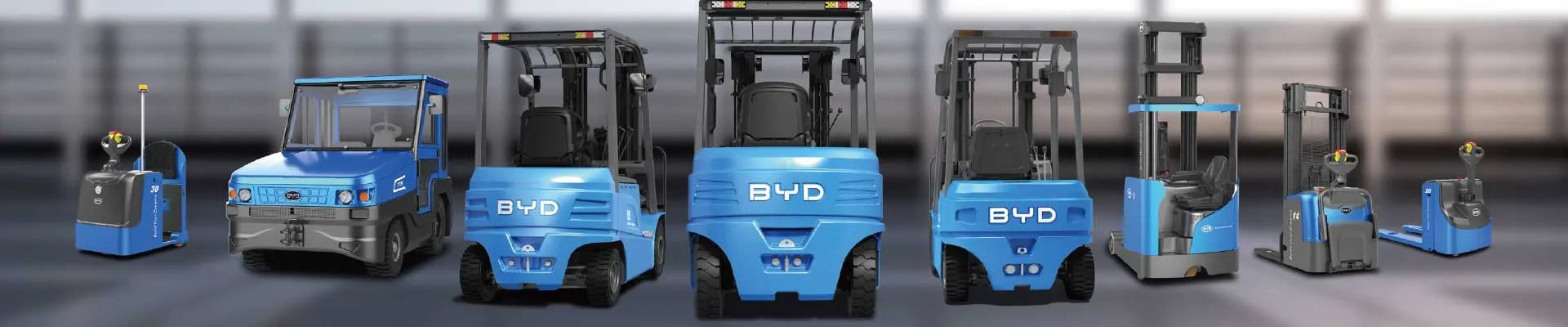
In response to such general needs of home appliance manufacturing enterprises, the rental purchasing solution launched by BYD Forklift can be customized according to the actual operation rhythm of the production line of the power plant, which is more in line with the long-term operation logic of the manufacturing enterprise. The first is the model adaptation process. A variety of models, such as 2-ton to 3.5-ton counterweight electric forklifts commonly used in home appliance production lines, forward-moving forklifts used in narrow passages, and pallet handling trucks for short-distance connections in workshops, can be included in the selection range of rental purchasing. The plan team will go to the factory in advance to survey the layout of the production line, the width of the working channel, and the average daily transshipment frequency, and match the corresponding load and parameter models to ensure that the vehicles are fully adapted to the daily use scenarios of the production line.
At the cost payment level, the down payment threshold set by the rental purchasing plan is relatively low, and the subsequent installment payment nodes can be adapted to the regular revenue collection cycle of the home appliance company, which will not occupy too much of the company's working capital. The company can invest the saved budget into core business links such as production line upgrades and new product research and development. At the same time, the plan will also include supporting services such as routine vehicle maintenance, regular safety testing, and rapid fault response into the scope of rights and interests. If there is a small failure of the vehicle during the daily operation of the factory, the local service personnel can come to the door within the agreed time limit to ensure that the transfer rhythm of the production line will not be interrupted at will.
In response to the common temporary order increment in the home appliance industry and the peak demand for capacity brought about by the concentrated launch of new products, the plan also supports the flexible addition of temporary spare vehicles to avoid the capacity gap slowing down the turnover efficiency of the production line. After the cooperation period expires, the company can not only complete the transfer of vehicle ownership in accordance with the agreed terms, but also choose to replace the new models adapted to the needs of the new production line. There is no need to invest a large amount of additional vehicle iteration costs, which is convenient for the company to flexibly adjust the vehicle configuration according to its own business development rhythm.
When planning the car plan for the production line, local home appliance manufacturers in Nantou can first sort out their monthly average transshipment frequency, the connection distance of the existing production line, and the capacity difference in the off-peak season, and then match the details of the rental purchasing plan. Select the car model that best meets their own operating needs, so that the logistics link in the field can stabilize and support the efficient operation of the production line, and reasonably control long-term operating costs.


