
 简体中文
简体中文 Русский
 Français
 Português
 Español
 لالعربية
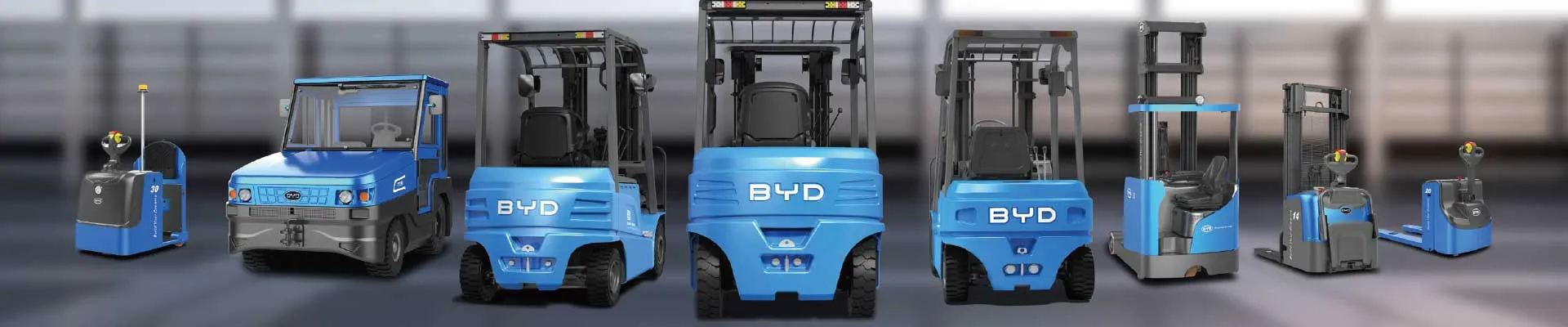

As the domestic warehousing and logistics industry gradually upgrades towards high-density storage, the proportion of high-shelf warehousing models continues to increase. The performance and adaptability of operating equipment in such scenarios will directly affect the space utilization rate of the warehouse area, the efficiency of cargo circulation, and the overall level of operation safety.
BYD's reach electric forklift has been targeted and optimized for the use of high-shelf storage scenarios, and its own many attributes can be well adapted to this kind of special operation scenarios. First of all, the fuselage structure is compact, and the reserved width of the channel required for operation is small, which can maximize the release of available storage space in the warehouse area. The door frame system has been specially adjusted, and the stability during the high-level lifting process is good. With the optimized operation vision design, the operator can clearly observe the alignment state of the fork and the pallet when accessing goods at a high level of several meters or even more than ten meters, reducing the probability of goods bumping and shelf scratching. Relying on its own battery technology advantages, this electric forklift has sufficient battery life and can meet the needs of multi-shift continuous operation in the warehousing industry. The operation process has no exhaust emissions, and it is also suitable for environmental protection operation requirements in closed high-rise storage areas.
In the actual high-shelf storage scenario, this equipment can cover a variety of core operation links. The most common is the whole pallet access operation of high-shelf shelves. The operator can smoothly complete the high-lift and drop of heavy objects through smooth power adjustment, and adapt to the cargo turnover needs of most conventional high-shelf shelves. In addition, in some narrow-channel dense storage areas, this equipment can also complete daily goods replenishment, picking and transshipment and other supporting work, without taking up a lot of operation channel space, indirectly improving the overall storage capacity of the warehouse area. In some high-shelf warehouses with floor operation requirements, the equipment's own weight is controlled within the compliance range, and it can also be adapted to the load-bearing standards of ordinary floor slabs to complete supporting operations across floors.
To make the equipment play a stable use value in the high shelf storage scene, the daily application process should also follow the relevant specifications. First of all, the operator needs to complete the corresponding special project operation training, familiar with the operation logic of high-level operations, check the status of the door frame and braking system in advance before operation, strictly abide by the moving line planning of the reservoir area during operation, and avoid high-speed driving in narrow passages. In the daily maintenance stage, regular maintenance of the power system should be done according to the requirements, and the debris on the surface of the equipment should be cleaned up in time to ensure the long-term stable operation of the equipment.
The rational application of this electric forklift to high-shelf storage scenarios can help warehouse operators balance the core requirements of storage capacity improvement, operation efficiency optimization, and long-term operation and maintenance cost control, and adapt to the current e-commerce industry, manufacturing raw materials, and finished product warehousing upgrade direction.


