
 简体中文
简体中文 Русский
 Français
 Português
 Español
 لالعربية
_zip.jpg "Baini Ceramic Factory peak season stocking period, BYD large-tonnage forklift short-term lease reference(figure1)")
The local ceramic industry in Baini is concentrated, and the production and sales rhythm of related enterprises shows obvious characteristics of light and peak seasons with changes in market demand. During the traditional peak season of stocking and shipping, the throughput of ceramic raw materials and finished products to be transshipped in the factory area has risen sharply. Many enterprises' original fixed-configuration handling equipment will have obvious capacity gaps, making it difficult to cover the operation requirements of multiple scenarios such as offline transfer of production lines, high-level stacking in warehouses, loading and outbound warehouses at the same time.
In the past, when many companies encountered such short-term capacity gaps, they either arranged for the existing equipment to operate beyond the conventional load, which could easily accelerate the aging of the equipment and increase the subsequent maintenance cost, or hired manual assistance for handling at a high salary temporarily, which was not only inefficient, but also easy to bump into ceramic products during handling and cause unnecessary losses. If they directly purchased new handling equipment, they would take up a large amount of working capital. After the off-season operation volume fell, the new equipment would most likely be in an idle state, and subsequent annual inspections and daily maintenance would also generate additional fixed expenses. The input-output ratio was not ideal.
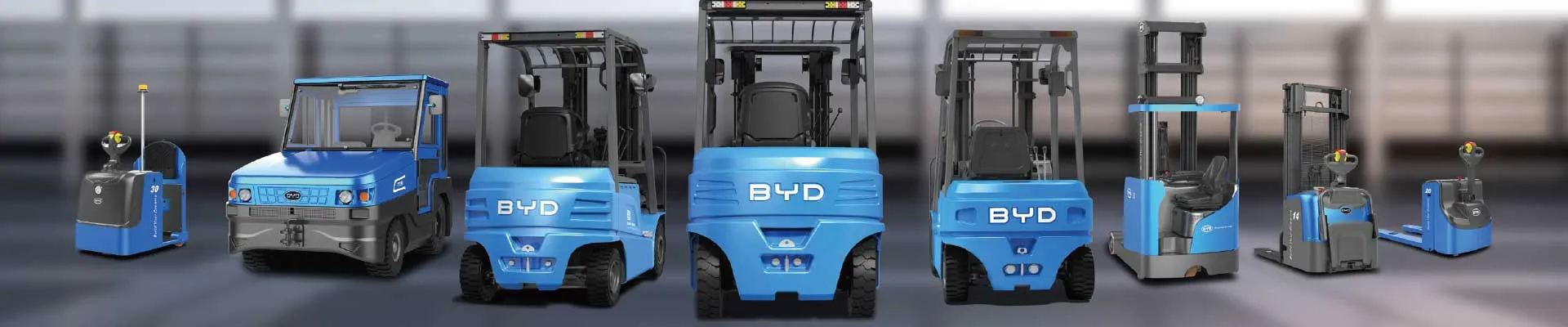
In this context, BYD's short-term rental of large-tonnage electric forklifts has become the choice of many local ceramic enterprises. This type of equipment itself is suitable for heavy-duty handling scenarios, with smooth power output and battery life to meet the needs of continuous operation in multiple shifts. The property of zero exhaust emissions also meets the environmental protection and control requirements of the ceramic factory area, and will not cause defacement to the ceramic products in storage.
When enterprises choose this kind of short-term leasing service, they can refer to several practical points. First, they must sort out their actual capacity needs in advance, and count the average daily operating time, the maximum load-bearing weight of a single piece of goods, and the height range of commonly used stacking during the peak season. Then confirm the corresponding model configuration with the leasing service provider to avoid the problem of parameter mismatch slowing down the operation efficiency. Secondly, they must finalize the service rules of the leasing package in advance, clarify the response time of daily maintenance, and the spare equipment deployment mechanism after the sudden failure of the vehicle, so as to minimize the risk of operation interruption in the peak season. Finally, they can choose the corresponding length of lease agreement based on the actual peak cycle of their own stocking and shipment. Without binding long-term contracts, they can accurately fill the short-term capacity gap and effectively control unnecessary operating expenses.
For the local ceramic enterprises in Baini, the rational use of such short-term rental services during the peak season stocking period can not only quickly replenish the handling capacity, ensure the smooth rhythm of production and shipment, but also optimize the allocation of enterprise liquidity and reduce the additional burden caused by idle equipment. It is a practical choice to adapt to the current industrial operation needs.


