
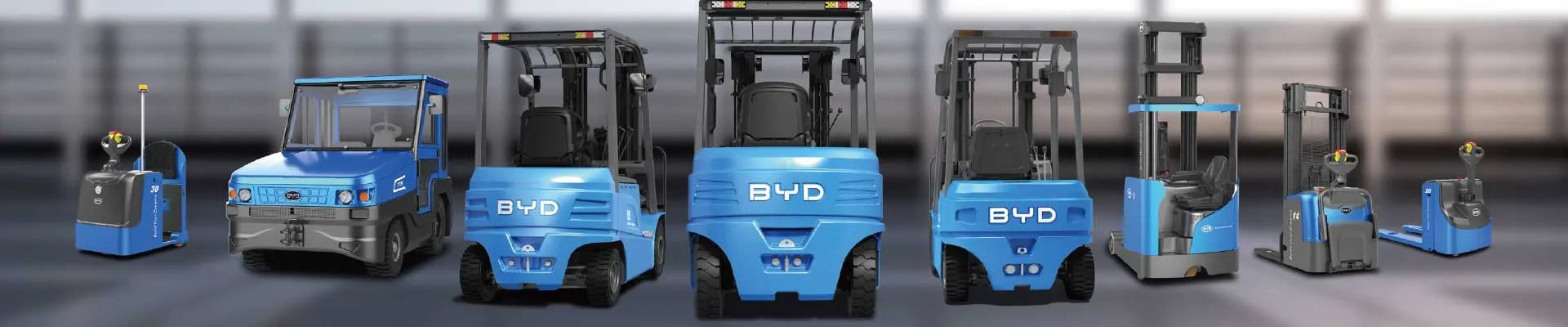

With the green transformation of the warehousing and logistics industry, the application coverage of electric handling equipment continues to increase. Many purchasers often confuse the positioning of three types of common equipment during the selection stage, making it difficult to match the products that best suit their own scenarios. Instead, it slows down the overall operation efficiency. We start from the actual operation dimension, clearly dismantle the functional differences of the three types of equipment, and give a practical selection reference standard.
The first is the difference in the core functions of the three types of equipment. The first type is the counterweight electric forklift, which is equipped with a special counterweight block at the tail of the body, does not require additional front support legs for load-bearing support, and has stronger site passability. It can not only work on the flat ground inside the warehouse, but also adapt to the outdoor hardened pavement in the factory area, and even cope with the gentle slope section. Its core advantage is that the function coverage is comprehensive, and the lifting height range is large. It can not only complete the long-distance horizontal transfer of pallet goods, but also complete the high-level stacking, truck loading and unloading operations. It can also carry a certain degree of partial load goods. It is suitable for a wider range of operation scenarios, and the corresponding turning radius of the body is also larger. When operating, a wider passage needs to be reserved.
The second type is electric stacker trucks. The design core of this type of equipment focuses on stacking operations, and most of them are equipped with front support legs. The overall body structure is very compact, and the lifting height is generally higher than that of ordinary handling equipment. The core function is to lift the pallet goods on the ground to the corresponding shelf height to complete the loading and unloading of goods. At the same time, it also supports short-distance movement to adjust the position. It only needs a narrow channel to complete the operation, which is very suitable for ordinary flat warehouses with shelf access as the core requirement.
The third type is an electric pallet truck. This type of equipment does not have a high-stroke lifting structure and can only lift the pallet to a small height off the ground. Its core function is to complete the horizontal transfer operation of large quantities of pallets. The overall body is light and flexible, and the width of the passage is extremely low. Even in scenes with very limited space such as the interior of the truck compartment and the back yard of the supermarket, it can pass smoothly. The operating threshold is relatively low, and ordinary staff can use it after simple training.
Next is the reference criteria for the specific selection stage. Users must first sort out their core operation requirements. If they need to complete truck loading and unloading operations frequently on a daily basis, have outdoor site transshipment needs, and also carry some irregular partial loads of goods, they can choose a counterweight electric forklift first. When selecting a model, check the parameters of operation channel width, maximum lifting height, and conventional load-bearing weight in advance to match the suitable model. If the core operation scenario is high-level shelf access inside the warehouse, with almost no cross-regional long-distance transshipment and outdoor operation needs, they can choose an electric stacker, and choose a walking or standing style according to the shelf height and channel reserved width. If the operation content is mainly based on the translation and turnover of pallets between various regions, and there is little need to complete high stacking frequently, electric pallet trucks can be selected first, and the corresponding load models can be selected according to the maximum weight of the daily single load.
During the selection process, you can also refer to the actual hardware conditions of the site simultaneously, such as ground flatness, ramp ratio, charging facility layout, and other factors. After comprehensive consideration, you can choose the most suitable equipment to ensure smooth operation and avoid unnecessary cost waste.


