
 简体中文
简体中文 Русский
 Français
 Português
 Español
 لالعربية
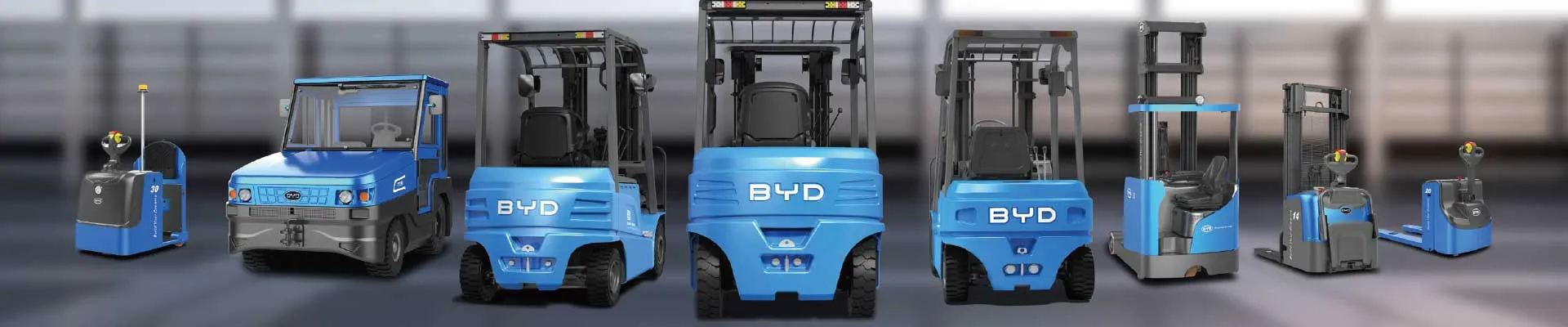

In the daily operations of Xiaolan's local industrial production plants, logistics distribution centers, and trade and wholesale parks, lithium-ion forklifts are widely used as short-distance handling core equipment. After many users choose BYD lithium-ion forklifts, they often pay more attention to the operation efficiency of the equipment. They are not familiar with the follow-up systematic maintenance, especially the maintenance details of the core power component battery. Long-term irregular use can easily lead to abnormal battery performance attenuation, and even sudden downtime, disrupting the overall operation rhythm.
Regarding the daily maintenance of lithium-ion forklift batteries, first of all, it is necessary to standardize the charging operation. After the daily operation, if the remaining battery power is less than 20%, it is necessary to arrange supplementary charging in time, and try to avoid booster charging after the power is completely exhausted. The charging link should choose a ventilated and cool designated area. Do not charge in an open-air environment where sunlight is exposed for a long time and rain is easy to splash. Daily attention should be paid to keeping the charging interface dry and clean, and timely clean up the metal debris, water stains, and dust attached to the interface. When plugging in the charging gun, confirm that the card is in place, and do not violently plug and unplug the gun head During daily operation, try to avoid overloading the equipment for a long time. Do not connect other electrical devices that do not meet the rated specifications from the battery. If the equipment needs to be idle for more than 7 days, adjust the battery power to 50% -70% in advance. Disconnect the total power supply of the vehicle and park it in a dry and flat indoor area. Do not store it in extreme environments above 40 degrees Celsius or below minus 10 degrees Celsius for a long time.
In view of the tight daily operation scheduling in many Xiaolan local factories, it is difficult to take the whole time to send the forklift to the site for maintenance. The compliance on-site inspection service can well adapt to the needs of such users. After professional training, the service personnel will arrive at the user's site with matching special testing equipment. First, they will check all the cells of the battery one by one, detect the voltage and internal resistance status of a single group of batteries, and check whether there are any hidden dangers of uneven performance attenuation and abnormal appearance. Then they will perform routine inspections on the control circuit, braking system, hydraulic lifting components, and walking mechanism of the vehicle synchronously, and promptly detect any hidden faults in the usual operation process. They can also explain practical maintenance precautions to the front-line operators on the spot, directly answering various questions encountered by users in daily use.
Long-term adherence to standardized daily maintenance, coupled with regular professional on-site inspections, allows lithium-ion forklifts to maintain a stable operating state, prolonging the overall service life of the equipment while effectively reducing subsequent unnecessary operation and maintenance expenses, providing sufficient protection for the smooth operation of the factory.


