
 简体中文
简体中文 Русский
 Français
 Português
 Español
 لالعربية
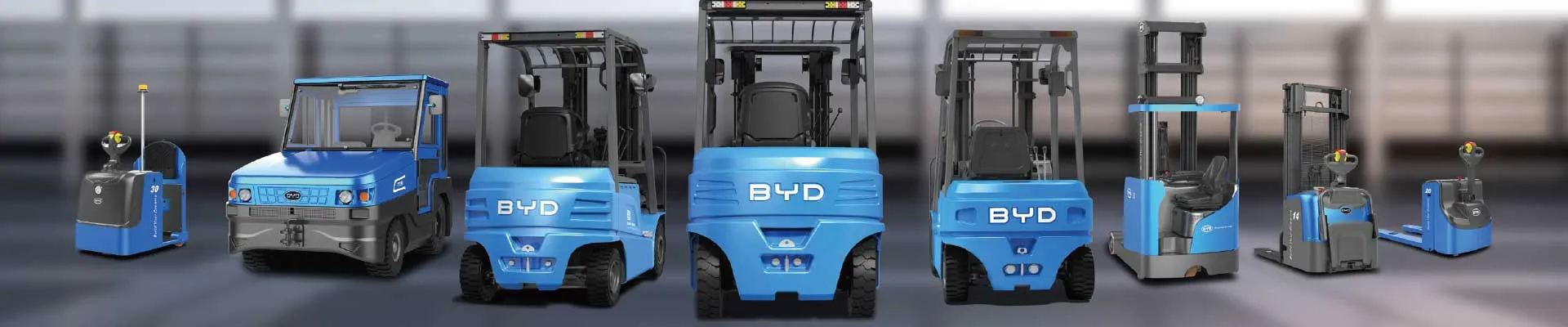

Beijiao is a well-known domestic home appliance industry cluster area, with a large number of home appliance production plants of different sizes. The daily operation process generally involves raw material transfer, workshop material supply, finished home appliances in and out of storage, warehousing high stacking and other types of handling scenarios. Many home appliance manufacturers will give priority to lithium-ion industrial forklifts with stronger adaptability when updating handling equipment. BYD lithium-ion forklifts, with their mature power technology support, can make targeted configuration matching for the actual operation needs of power plants.
The first part is the basic procurement cost of the forklift body. This part of the budget is fully combined with the actual operation needs of the power plant. If it is used for short-distance transportation within the factory workshop, the commonly used 2-ton counterweight lithium forklift is within the normal and reasonable range of industrial equipment. If it involves the demand for high-level storage and stacking, the required stacking lithium forklift will have a corresponding rise according to the actual lifting height. The second part is the optional budget for supporting accessories. There are many categories such as home appliance shells and finished packaging parts that need to be transported daily in the power plant. Exclusive attachments such as extended fork arms and fork anti-skid parcel pads can be selected on demand. The special charging pile installation service in the factory area, the heavy reminder installed on the forklift, and the auxiliary features such as the identification of the operation area authority are also optional configuration value-added items. Enterprises can choose to include them in the budget according to their actual needs. The third part is to reserve the budget for medium and long-term operation and maintenance. The operation and maintenance complexity of lithium-ion forklifts themselves is low. Conventionally, only the relevant costs of daily wearing parts replacement and regular safety testing need to be reserved. There is no need to reserve the oil consumption and frequent maintenance of power components of traditional internal combustion forklifts. In the long run, the overall investment is more controllable.
Secondly, the accounting logic of the configuration quotation shows that all quotations will be strictly calculated according to the actual operation requirements submitted by the power plant. The service personnel will first come to the site to survey the operating channel width, storage shelf height, daily single handling weight, and average daily operation time of a single forklift. These core parameters, and then match the appropriate lithium battery capacity, body size, and power output parameters of the model, neither will there be unnecessary cost waste caused by configuration redundancy, nor will there be insufficient configuration to meet the operation needs. The quotation process will clearly list all the cost items involved, and there will be no invisible consumption. At the same time, according to the characteristics of the low and peak season operation fluctuations of the power plant, a flexible procurement plan will be given for reference, so as to help the power plant fully meet the handling needs of daily production under the premise of controlling input costs. When a power plant is making relevant procurement planning, it can sort out its own daily handling data in advance, and make accurate adaptation calculations for the corresponding equipment suppliers, so that it can quickly obtain a reasonable quotation plan that meets its own needs.


