
 简体中文
简体中文 Русский
 Français
 Português
 Español
 لالعربية

The local hardware manufacturing industry cluster in Danzao is relatively large, and many hardware factories that have been in operation for many years have been promoting the upgrading and transformation of production lines in recent years. During the transition stage from the completion of installation and commissioning to full production of new production lines, there are often practical problems in the adaptation of handling capacity. In many factories, the pace of capacity climbing at this stage is not stable, and the difference between peak and valley value of material transfer is large. If a fixed number of forklift equipment is directly purchased, it is easy to experience insufficient capacity during peak production and idle equipment during low peak periods. At the same time, the layout of the workshop channel of the new production line, the specifications of the material pallet, and the shelf height of the finished product storage are often different from the original standards in the old factory area. It is difficult for the old forklift trucks previously configured to fully adapt to the operation requirements of the new scene, which brings many obstacles to the daily production progress.
In response to the special handling needs of the transition stage of new production lines such as Danzao Hardware Factory, the medium and long-term leasing plan launched by BYD Forklift can well match the characteristics of the scene and effectively solve the practical problems faced by the factory. The first is that the flexibility of the plan is strong. The leasing cycle can be flexibly agreed according to the factory's production line commissioning cycle and production capacity climbing progress, covering a range of months to several years. The factory does not need to invest large amounts of procurement funds at one time. The working capital originally used for handling equipment can be transferred to the commissioning of new production line equipment, core raw material reserves, and skills training of front-line workers, which are more in need of financial support. This will help the factory optimize the overall cash flow structure and reduce the financial pressure during the investment period of the new production line.
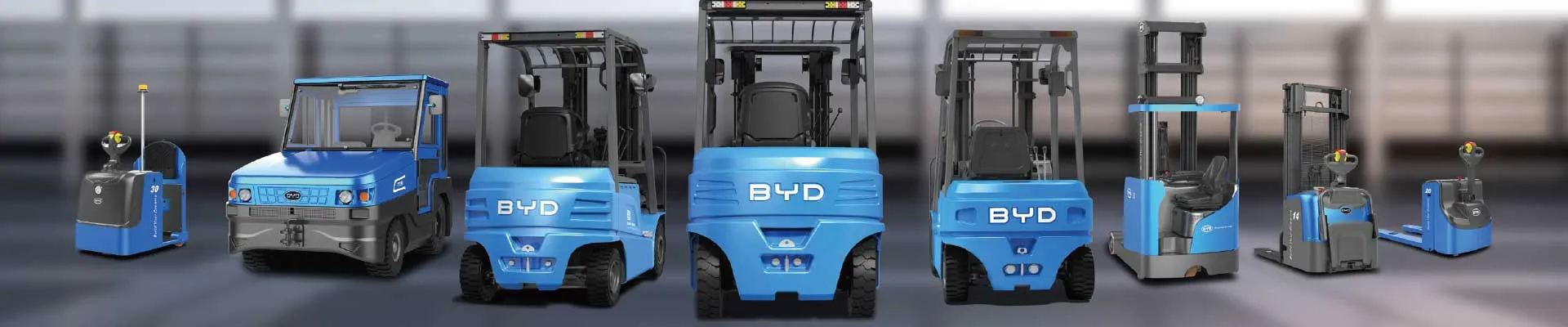
At the level of model configuration, the medium and long-term leasing plan supports the selection of corresponding handling equipment on demand, aiming at the handling objects of different weights such as heavy metal workpieces, raw metal rolls, and bulk finished packaging boxes that hardware factories need to transfer on a daily basis. Whether it is a counterbalanced electric forklift suitable for narrow channel operations or an electric stacker suitable for high-level shelf access needs, the configuration plan can be adjusted according to the actual layout of the new production line, eliminating the need for factories to adjust the production line layout in order to adapt the parameters of forklifts, eliminating additional production line transformation costs.
During the period covered by the leasing service, the daily regular maintenance of the vehicle, door-to-door repair for faults, replacement of conventional worn parts and other related supporting services are included in the agreed service scope. The factory does not need to arrange additional full-time forklift maintenance personnel to be responsible for equipment operation and maintenance, but only needs to coordinate the daily scheduling of forklifts. When the new production line is fully produced and the production capacity is further expanded, the factory can also apply to increase the number of leased forklifts at any time. If the production layout is adjusted and the product category is changed later, it can also negotiate the replacement of models suitable for new scenarios. There will be no problem of idle waste after the elimination of its own equipment.
At present, many local hardware manufacturing enterprises in Danzao are choosing this kind of medium and long-term leasing plan in the transition stage of the new production line to smoothly survive the unstable cycle of production capacity climbing, and gradually build an internal handling system that adapts to the new production rhythm. The overall handling operation cost is more controllable, and it also allows the factory to focus more on the polishing of the core production business.


