
 简体中文
简体中文 Русский
 Français
 Português
 Español
 لالعربية
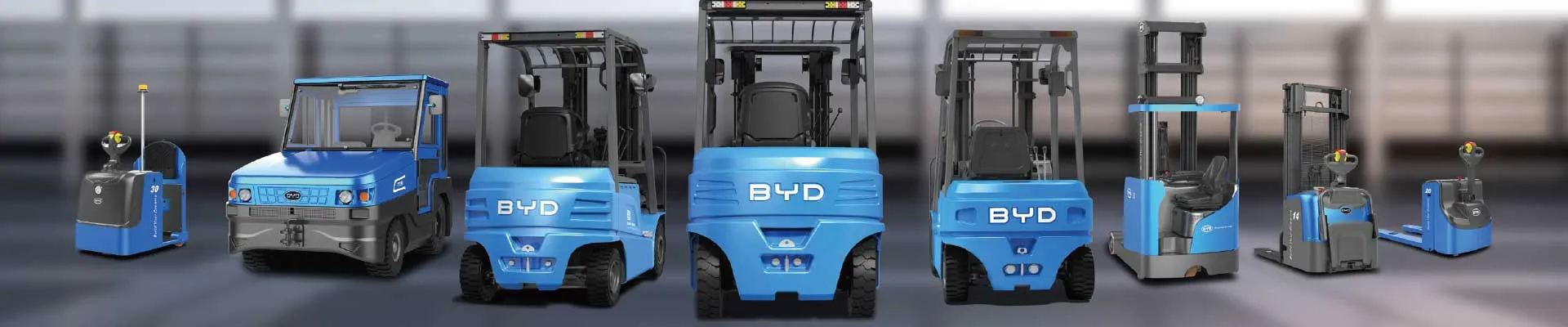
.jpg "Description of core technical characteristics of BYD blade battery lithium battery forklift(figure1)")
At present, the electrification transformation process in the domestic industrial handling field is accelerating, and lithium-ion forklifts have gradually become an alternative to traditional internal combustion forklifts by virtue of their outstanding advantages of low operation and maintenance costs and zero exhaust emissions. BYD lithium-ion forklifts equipped with blade batteries rely on the technical accumulation in the field of power batteries to complete directional optimization for the actual needs of high-frequency start-stop, heavy-load operations, and complex working conditions in industrial handling scenarios. Many core technical features are highly adapted to the daily use requirements of different industries.
The first is the safety performance of the power system, the blade battery adopts a flat exclusive structure design, the utilization rate of the internal space of the battery pack is effectively improved, the module integration link reduces the redundant additional structure, the overall anti-extrusion and impact performance of the battery is excellent, and the special project adaptation is completed for the accidental bumping that may occur during the operation of the forklift and the extreme temperature environment in different regions.
Secondly, the cost advantage of the whole life cycle is different from the power battery system of conventional lithium-ion forklifts. This lithium-ion forklift equipped with a blade battery performs well in charging and discharging cycles, and the capacity attenuation during the full life cycle is controlled within a reasonable range. There is no need to replace the power battery frequently in the middle of the life cycle, which greatly reduces the comprehensive investment cost of the whole life cycle of the equipment. Users can obtain long-term stable power output by doing basic maintenance in accordance with the operating specifications.
In addition, it is the ability to adapt to wide-area working conditions. In response to the common use requirements of cross-temperature zones in industrial scenarios, this power system is equipped with an intelligent temperature control management system. Whether it is the low-temperature open-air operation scene in the northern winter or the high-temperature closed storage space in the southern summer, the battery can maintain a stable charging and discharging efficiency, and there will be no power output plunge and charging speed drop significantly. At the same time, the equipment supports short-term fast charging and replenishment, and the operator can use the fragmented time of the break to complete the power replenishment. There is no need to configure a large-area battery replacement compartment to adapt to the production requirements of multi-shift continuous operations.
Finally, there is the convenience of intelligent operation and maintenance. The vehicle's power management system is equipped with a fully visual parameter monitoring module, allowing the operator to view various core parameters such as the remaining battery power, operating temperature, and health status in real time, making it convenient for managers to uniformly schedule the operation of forklifts, check potential minor faults in a timely manner, and reduce the probability of unplanned downtime. The vehicle has no exhaust emissions during operation, and the operating noise is much lower than that of traditional internal combustion forklifts. It can also be used in food, medicine, and other indoor scenarios that require high cleanliness of the operating environment. It has been applied in warehousing and logistics, manufacturing, port freight, and other fields. It fits the industry development trend of green logistics and provides various users with a more secure choice of industrial handling equipment.


