
 简体中文
简体中文 Русский
 Français
 Português
 Español
 لالعربية
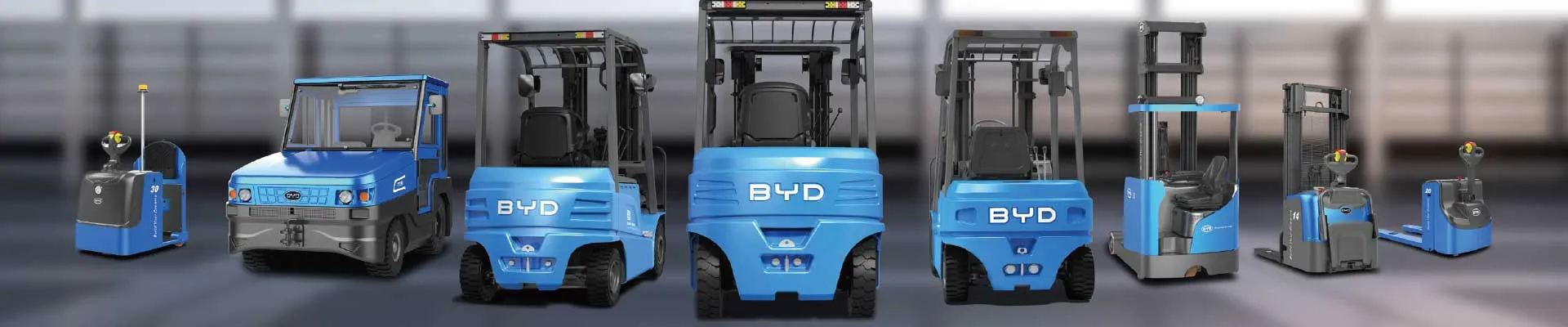

Dongfeng is a well-known small household appliance industry agglomeration area in China. A large number of local small household appliance finished warehouses generally have the operating characteristics of high frequency of goods circulation, obvious tidal characteristics in and out of warehousing, and easy scratching of finished product packaging. It has high requirements for the stability and flexibility of warehousing operations. With multiple BYD electric forklifts being put into the daily operation of finished product warehouses in batches, a standardized operation system suitable for local warehousing scenarios has been established, which can effectively straighten out the operation logic of each link and ensure the orderly progress of daily warehousing operations.
The first step is to prepare for the operation. All on-duty operators should check the status of the vehicle in advance, check the remaining power of the vehicle, the sensitivity of the braking system, the smoothness of the lifting gantry, and the wear degree of the fork one by one. After confirming that there is no abnormal situation, start the operation. At the same time, the operator should check the warehousing work order of the day in advance, clarify the packaging specifications and weight of the finished goods of small household appliances to be transferred, and adjust the spacing of the forks in advance to avoid scratching the outer packaging of the product during the subsequent fork picking process. It is also necessary to confirm the passage route in the warehouse on the day in advance, actively avoid the crowded manual picking area, and reserve a safe working space in advance.
The second is the core execution link of batch operation. When multiple electric forklifts cooperate to carry out inbound and outbound operations, the exclusive operation area of each vehicle should be delineated in advance to reduce the congestion caused by the overlap of operation routes. According to the guidelines of the warehouse management system, priority should be given to processing orders approaching the delivery period. Vehicles should maintain a reasonable and safe speed when driving in the warehouse. They should sound their horns in advance in restricted areas such as storage corners and platform entrances and exits. After forking the goods, adjust the forks to a safe height of 10 to 20 centimeters from the ground and then drive smoothly to avoid scratching the raised parts of the ground pipelines and pallets. During the stacking operation of goods, the operator should lift the goods to the corresponding shelf height and then push and place them smoothly. The whole process should be controlled to reduce the deformation of the finished packaging of small household appliances caused by the impact force and reduce the additional quality inspection workload in the subsequent delivery process.
Finally, there is the finishing link after the daily operation. After all the daily operation tasks are completed, the operator should park the electric forklift to the designated charging parking area, pull the handbrake, completely lower the door frame, organize the operation registration ledger of the day, and synchronously feed back the operation status of the vehicle on the day to the warehousing management department. Cooperate with the maintenance personnel to carry out regular daily maintenance of the vehicle to ensure the stability of subsequent operations. The whole set of operation procedures that fit the scene can give full play to the advantages of electric forklifts, adapt to the high-frequency and high-density warehousing operation needs of the finished warehouse of small household appliances, and gradually improve the overall operation fluency of the warehousing process.


