
 简体中文
简体中文 Русский
 Français
 Português
 Español
 لالعربية
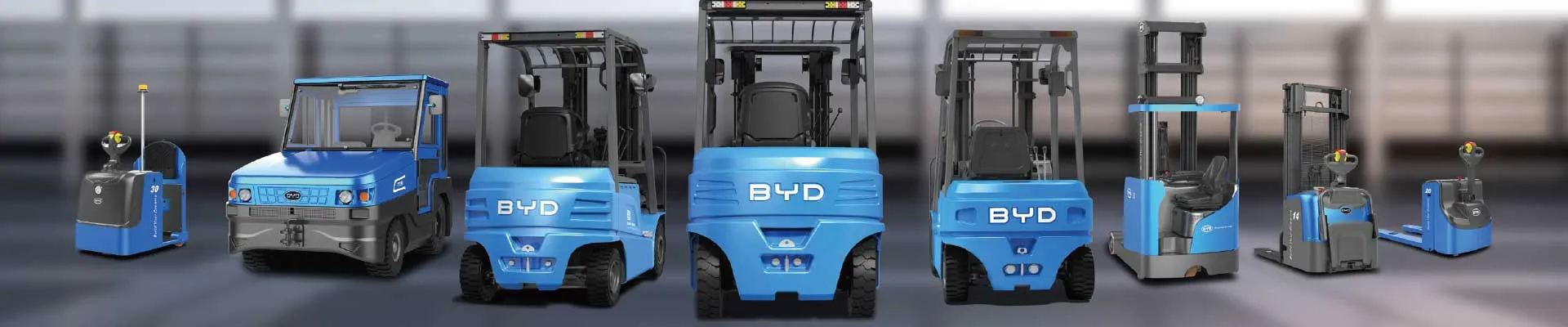
.jpg "Humen clothing warehouse light load handling 2 tons BYD electric forklift adaptation scene description(figure1)")
Humen, as a highly concentrated area of the domestic clothing industry, is home to a large number of different scales of clothing finished products and fabric storage spaces. The daily handling requirements of such storage scenarios have distinct industry attributes and belong to a typical light-load high-frequency operation scenario.
First of all, the conventional handling goods in Humen clothing warehouses are mostly stacked clothing boxes, packaged fabric rolls, and hanging clothing turnover racks. The vast majority of single-batch handling weights are concentrated in the 1.5-ton to 2-ton range. Many small and medium-sized clothing warehouses built in the early years generally have the characteristics of narrow channel widths and high storage density of goods. Some scenes also require short-distance transshipment between the loading and unloading area on the first floor and the storage area on the second floor. The operating hours of the OurHours section cover the full business cycle during the day, and there are high requirements for the safety and environmental suitability of the handling equipment.
The parameter design of the 2-ton BYD electric forklift just matches the core requirements of such scenarios. Firstly, its rated load range fully covers the vast majority of daily handling needs of clothing warehouses. For goods that are afraid of bumping, such as fabrics and finished clothing, the power output of the vehicle is adjusted smoothly, and there will be no obvious impact during the start and stop process. This can effectively avoid problems such as shaking and sliding of goods, scratching of clothing packaging, and scattered fabrics, and reduce unnecessary goods loss.
The body size of this model has been specifically optimized, and the whole process of steering, picking up and releasing goods can be smoothly completed in a narrow storage channel with a width of only about 2.8 meters. There is no need to adjust the location of the goods stored around, and it is suitable for the space conditions of many small and medium-sized clothing warehouses in Humen. At the power level, the power battery on the vehicle is adapted to the needs of long-term high-frequency operations. A single full charge can meet the continuous handling operations of conventional clothing warehouses for more than 8 hours a day. The charging process is convenient to operate. The warehouse area only needs to be equipped with charging points that meet safety regulations. There will be no exhaust emissions throughout the process, and there will be no additional oil maintenance expenses. It is very suitable for the relevant requirements of clothing warehousing for fire prevention and clean working environment.
From the perspective of subdivision and adaptation scenarios, the first is the conventional finished product box transfer scenario, that is, the warehouse daily transports the warehoused full boxes of clothing from the loading and unloading area to the designated storage space, or picks out the corresponding goods and transports them to the outbound area according to the order requirements. This kind of high-frequency and light-load operation fully matches the rated load range of this forklift, and the operation is smooth. Secondly, the fabric roll short-distance transfer scenario, the weight of the whole bundle of textile fabrics is generally between 1.2 and 1.8 tons. The use of this forklift with adapters can be transferred smoothly, and there will be no situation where the fabric roll is tilted and dropped. The third type is the hanging clothing turnover operation scenario. Some clothing warehouses need to transfer complete sets of clothing with hangers. The load balance of this forklift can fully cover the corresponding weight, and the operation process is smooth, without the problem of hanger dumping and clothing wrinkles.
The garment warehouse in Humen area can choose the appropriate equipment according to its own daily handling frequency, the width of the channel in the warehouse area, and the weight range of common transshipment goods, so as to further optimize the overall turnover efficiency of the warehouse and reduce the comprehensive cost of long-term operation.


