
 简体中文
简体中文 Русский
 Français
 Português
 Español
 لالعربية
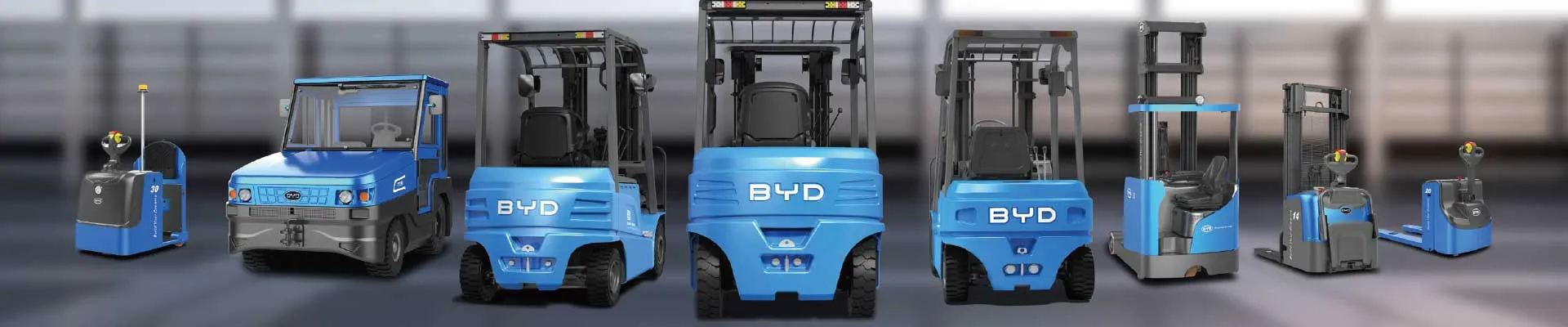

As an important manufacturing cluster in the country, Guangdong has a complete industrial system and rich manufacturing scenarios. On-site handling operations are an indispensable part of the production link of most manufacturing enterprises. Since the implementation of the "14th Five-Year Plan" industrial green development plan, Guangdong Province has issued a number of special project guidance documents around the low-carbon transformation of the manufacturing industry. It clearly regards the emission control of non-road mobile machinery as one of the core work modules of industrial carbon reduction, and provides a clear development direction for the upgrade of commonly used handling equipment in the field.
For a long time in the past, fuel-powered forklifts were the main equipment for material transfer in manufacturing enterprises, and the emissions of particulate matter and volatile organic compounds generated during their operation were one of the important sources of unorganized pollution in the factory area. In response to this situation, the province's ecological and environmental authorities first completed the registration of non-road mobile machinery in the province, and gradually expanded a number of high-emission non-road mobile machinery prohibited areas in the Pearl River Delta core manufacturing belt. Fuel forklifts that do not meet the latest emission requirements will not be able to be put into use within the designated parks and factories, forcing manufacturing enterprises to speed up the elimination of high-emission old handling equipment from the regulatory level.
In order to reduce the transformation burden of manufacturing enterprises, various cities in the province have successively introduced supporting incentive policies related to the electrification of forklifts in light of their own industrial development. Some prefectures and cities have provided corresponding proportion of purchase subsidy support to manufacturing enterprises that actively eliminate high-emission fuel forklifts and purchase electric handling equipment in compliance; at the same time, many places have included the electrification rate of handling equipment in the factory area into the evaluation index system of green factories and low-carbon demonstration enterprises, and guided manufacturing enterprises above designated size to take the lead in completing the electrification upgrade of on-site handling links, forming a low-carbon transformation experience that can be replicated and promoted.
At present, Guangdong electronic information, advanced equipment, light manufacturing, new energy and other advantageous industrial fields, forklift electrification popularization progress continues to accelerate, many provincial industrial parks will also be on-site handling equipment fully electric into the park green supporting construction standards, from the park access to clear the relevant low-carbon requirements, from the source to reduce the pollutant emissions of non-road mobile machinery, help the province's manufacturing industry to steadily complete the unit industrial value-added carbon emissions phased assessment goals. In the future, relevant departments will continue to improve the layout of supporting infrastructure, promote the extensive coverage of charging and swapping outlets in industrial parks, further reduce the comprehensive cost of manufacturing enterprises to promote the electrification of forklifts, and open up the carbon reduction and blocking points in the logistics links at the end of the field. This will provide a solid support for the province's industrial sector to smoothly achieve the goal of double-carbon phase.


