
 简体中文
简体中文 Русский
 Français
 Português
 Español
 لالعربية
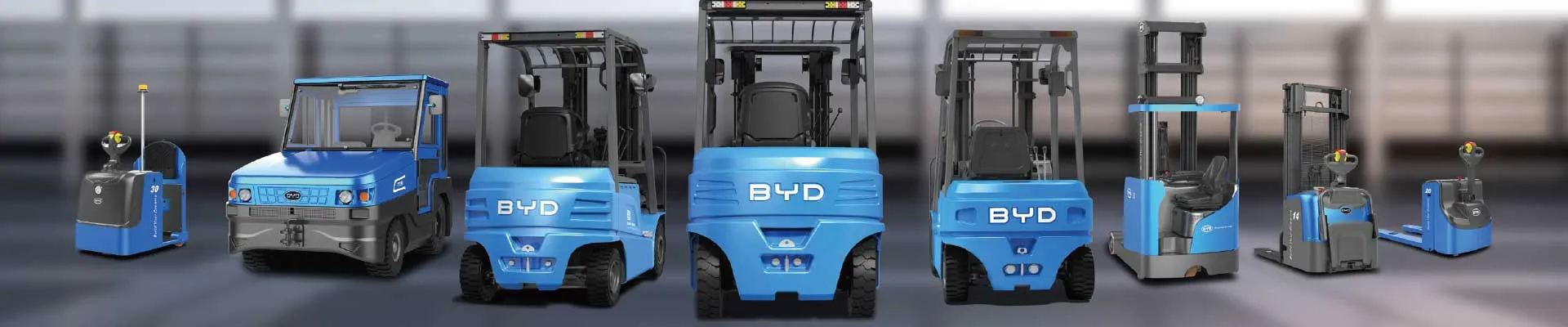
.jpg "Install the finished warehouse of small household appliances, BYD standard forklift conventional warehousing operation plan(figure1)")
The small household appliance industry in the installation area has a high degree of clustering, and the corresponding finished product warehouses generally have the operating characteristics of multiple SKU categories, high turnover frequency of finished products, and high stacking regularity requirements. Adapting to BYD standard forklifts to formulate exclusive conventional warehousing operation plans can fully match the needs of warehouse operations, taking into account operational efficiency and operational safety.
In the preparation process before the operation, all forklift operators need to complete the corresponding operation specification assessment before taking up their posts. Before starting the forklift operation every day, they need to complete the routine inspection of the whole body to confirm that the power is in the normal range, the braking system is responsive, the lifting arm runs smoothly without cards, and there are no obstacles around the body to block the field of vision. Operators need to wear complete labor protection equipment as required, comb the batch information of small household appliances to be put into and out of the warehouse on the same day in advance, mark the corresponding storage area, plan the operation line in advance, and avoid the pedestrian passage and temporary parts turnover area reserved in the warehouse to avoid the intersection of people and vehicles.
In the regular operation of warehousing, when carrying out warehousing operations, the forklift connects the finished goods of the whole small household appliances from the unloading area. The fork should be completely inserted into the bottom of the tray, and the spacing of the fork arms should be adjusted to ensure that the force on both sides of the tray is uniform. The fork should be lifted to a height of about 10 cm from the ground. The whole process should be operated at a low speed. After passing through the corners, entrances and exits, and fire channels in the warehouse, the horn should be honked in advance to indicate avoidance. After arriving at the designated warehousing space, adjust the height of the fork to match the height of the corresponding cargo layer. Smooth push the tray to the designated position. After confirming that the tray fully fits the cargo space card, slowly drop the fork. After pulling out the fork, record the warehousing space information of the corresponding finished product. The same batch of finished products are arranged from the inside to the outside in the order of Channel spacing. When carrying out outbound operations, check the batch logo of the finished product to be shipped out in advance, confirm that the cargo space information is accurate, and then drive the forklift to pick up the goods. Keep the action smooth during the lifting of the pallet, and then move the vehicle after confirming that the pallet is completely stable. After transporting the finished product to the outbound sorting area, put it down smoothly, and cooperate with the inventory personnel to complete the outbound verification.
Special scenarios and end-of-job management. When carrying out high-level cargo storage operations, the forklift is only used as a climbing auxiliary mobile tool. The operator needs to stand on the supporting compliance operation platform to complete the inventory operation. It is forbidden to directly stand on the fork to carry out aerial work. After all the operations are completed on the same day, the forklift needs to be parked in the designated charging and parking area, the handbrake is pulled, all the forks are lowered, the power supply of the whole vehicle is turned off, and the packaging debris and dust contaminated by the body are cleaned up. Do a good job of the day's operation ledger records, and regularly cooperate with the warehouse management personnel to complete the full-dimensional routine inspection of the forklift. Supplement lubricating consumables as needed to ensure that the vehicle is always in good operating condition. The whole set of solutions is fully adapted to the daily operation rhythm of the finished warehouse of small household appliances, which can ensure the stable


