
 简体中文
简体中文 Русский
 Français
 Português
 Español
 لالعربية
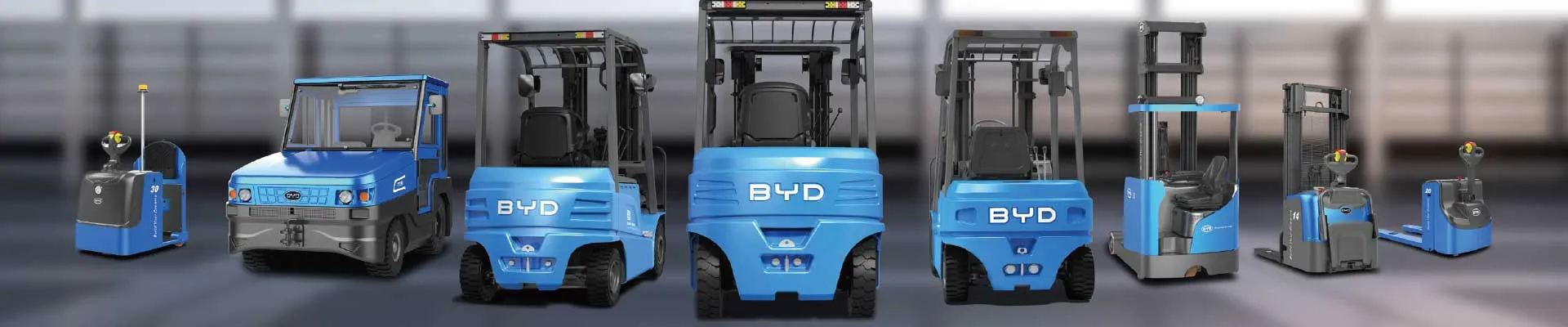
.jpg "Guiyu BYD forklift maintenance, in-depth maintenance instructions for models in complex environments(figure1)")
The operating environment of many industrial warehouses and freight transit sites in Guiyu has the characteristics of high dust concentration, complex ground conditions, and high frequency of cargo loading and unloading operations. Electric forklifts that have been operating in such scenarios for a long time are often difficult to cover all loss points. Targeted in-depth maintenance is the core support to ensure the stable operation of vehicles.
First of all, it is necessary to do a good job in the daily pre-inspection process. Before and after each operation, the operator can quickly complete the basic appearance inspection, focusing on the residual debris in the gap of the walking wheel and the position of the movable joints of the door frame, and promptly clean up the fine debris stuck in the gap to avoid the debris from rubbing against the surface of the parts for a long time. At the same time, synchronously check whether the brake sensitivity, power display status, and lighting warning function are normal to eliminate basic hidden dangers.
For long-term high-load operation of electric forklifts, after reaching the corresponding rated operating hours, professional maintenance personnel should be arranged to carry out in-depth maintenance operations. Priority should be given to the comprehensive dismantling and cleaning of the power battery compartment and motor heat dissipation components, cleaning up the dust accumulated in the heat dissipation air duct, and checking the fastening status of each terminal to avoid the problem of loose wiring under long-term high-frequency vibration. Non-professionals should not disassemble vehicle electrical components at will to prevent safety hazards caused by improper operation.
For the operation scenarios with high demand for cargo loading and unloading, during the in-depth maintenance process, it is also necessary to check the operating status of the hydraulic system, check the sealing of the hydraulic pipeline, and check whether there are any signs of oil leakage. At the same time, the tension of the door frame chain and the response sensitivity of the control handle are calibrated and adjusted. Combined with the actual situation of the concave and convex ground in the site, regularly check the wear uniformity of the tire surface, and correct the deviation in time to avoid the problem of driving deviation.
Each user can flexibly adjust the maintenance cycle according to their actual operation intensity and the density of debris in the site environment. Forklifts that operate in high dust and high load scenarios for a long time can appropriately shorten the interval of deep maintenance. After each maintenance is completed, the corresponding vehicle operation records are made, which is convenient for follow-up tracking of component loss rules, troubleshooting potential faults in advance, and reducing unexpected outage losses. The in-depth maintenance of compliance specifications can not only prolong the overall service life of the vehicle, but also keep the operation safety of the forklift within the qualified range, providing stable capacity support for daily production operations.


