
 简体中文
简体中文 Русский
 Français
 Português
 Español
 لالعربية
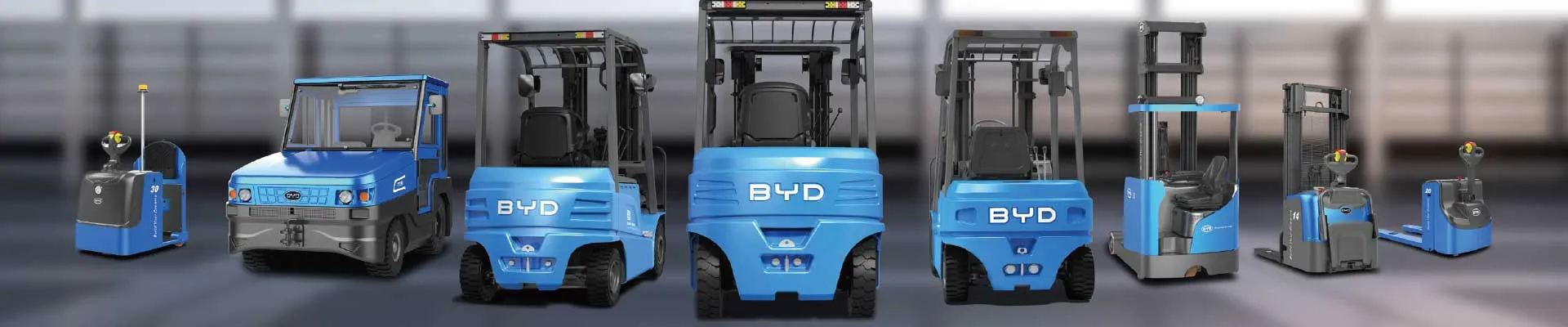
_zip.jpg "Selection and Dimension Reference of Electric Forklift for Narrow Channel Operation(figure1)")
At present, in order to improve the utilization rate of storage space, many storage scenarios will compress the reserved passage width between shelves, forming a large number of narrow operation channels. Conventional handling equipment is difficult to smoothly complete operations such as passage and stacking. Electric forklifts that adapt to the needs of the scene have become the core tool for improving operation efficiency in such venues.
Before selecting the model, it is first necessary to complete the accurate mapping of the on-site parameters. Do not directly refer to the marked channel width of the site design. Measure the net traffic width of the channel on the spot, and deduct the space occupied by the shelf protruding parts, ground bumps, and side pipelines to obtain the real usable traffic parameters. At the same time, it is also necessary to clarify its own core operation requirements. For example, if you only need to complete the plane cargo transfer in the channel, you can give priority to the minimum turning parameters of the vehicle. If you want to cooperate with the high-rise shelf to complete the high-rise cargo access, you must also synchronously confirm the lateral stability performance under the maximum lifting height of the vehicle. Scenes with high daily operation time can match the power configuration of the corresponding battery life class to reduce the impact of frequent replenishment on the operation rhythm
At the size reference level, the adaptation margin standards corresponding to different operation requirements are different. Only in the scenario of straight traffic plane transfer, the clear width of the channel can refer to the minimum turning radius of the vehicle and superimpose the operating margin of 100 to 200 mm, which can meet the smooth passage needs of most ordinary operators. If it is necessary to directly complete the operation of fork lifting and stacking and accessing goods in the channel, additional redundant space for fork lateral adjustment should be taken into account to avoid goods or forks scratching the surface of the shelves on both sides, reducing the probability of damage to goods and equipment loss. If there are multiple turning nodes in the channel, it is necessary to focus on measuring the effective passage space at the turning point. It is not possible to directly copy the size parameters of the straight to select the appropriate model to avoid the problem of vehicles getting stuck and unable to pass at the turning position.
In the selection process, we should also pay attention to avoid common misunderstandings, and do not blindly pursue extremely small body sizes. Excessive compact body structures may cause problems such as reduced handling stability under high load conditions, which can easily lead to unnecessary hidden dangers such as goods falling and personnel bumping. Do not directly copy the selection experience of other venues. The ground flatness of different operation scenarios, the outer dimensions of conventional handling goods, and the arrangement of shelves are all different. Only by informing the supplier of the scene parameters measured on the spot can we select the equipment with the highest degree of adaptation, which can not only make full use of the idle space of storage, but also ensure the safety and smoothness of daily operations.


