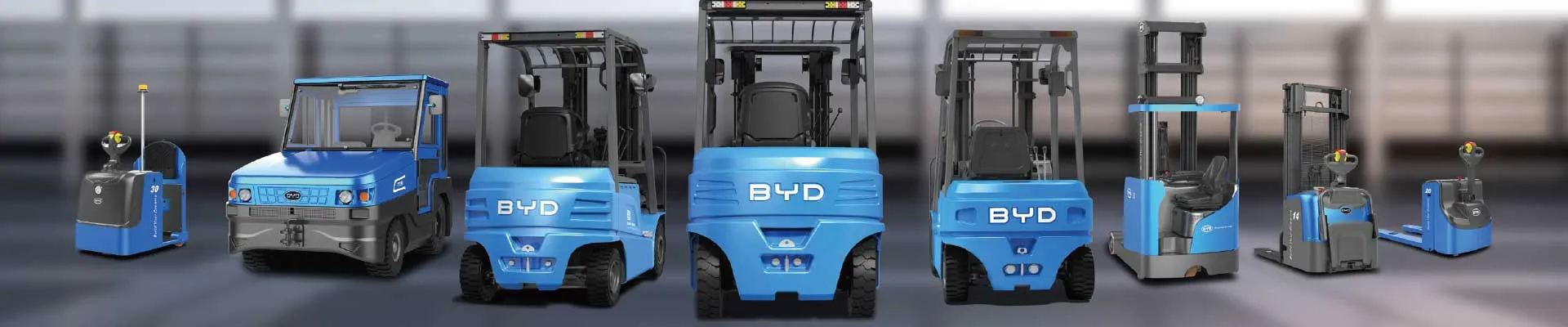
Mingcheng BYD anti-corrosion forklift maintenance, special model maintenance item reference

2026-09-04

Mingcheng BYD anti-corrosion forklift maintenance, special model maintenance item reference(figure1)

The maintenance logic of BYD anti-corrosion forklifts used in the Mingcheng area under special working conditions such as chemical storage, aquatic product processing, and coastal high salt spray is obviously different from that of ordinary electric forklifts. It cannot directly apply the general maintenance standards of conventional models. It is necessary to combine the design characteristics of the anti-corrosion structure and formulate a suitable maintenance plan in order to fully retain the anti-corrosion protection performance of the whole vehicle and prolong the service life of the equipment.

The first is the daily basic inspection maintenance project, which requires the operation and maintenance personnel to complete the operation according to the specifications before and after each operation. First, check the integrity of the exposed anti-corrosion coating of the whole vehicle, focusing on the parts of the fork arm, the body chassis, and the operating handle base that frequently experience friction and collision, and confirm whether the coating falls off or bumps to the bottom. If small area damage is found, it should be recoated in a timely manner to avoid corrosive media from invading the metal substrate along the damaged part and causing deep corrosion. The second is to do a good job of cleaning the attachments on the tires and rims. After each operation, the corrosive waste liquid and salt crystals attached to the rim should be cleaned in time to avoid long-term adhesion to accelerate the corrosion and cracking of the rim. At the same time, clean up the hard impurities left in the gaps of the tire pattern to avoid sharp debris scratching the outer layer of the rubber and reducing the overall anti-corrosion sealing performance. The third is to check the status of the sealing strip of the battery compartment. The battery compartment of the anti-corrosion model has made an exclusive sealing protective structure. Each inspection should confirm that the rubber strip is not cracked or displaced. After the warehouse door is closed, the gap is uniform to prevent corrosive water vapor from infiltrating and damaging the internal power system.

The second is the monthly in-depth maintenance project, which requires the equipment to carry out a special project maintenance every 100 hours of operation or 30 days of the natural month. First, the movable hinge parts of the whole vehicle, such as the gantry hinge, steering joint, and brake pin, after cleaning up the residual corrosive adhesives on the surface, apply suitable anti-corrosive grease. Conventional grease under ordinary working conditions cannot be used to avoid the grease from rapidly decomposing in case of corrosive media, resulting in the problem of stagnation and poor rotation of the hinge parts. Second, check the state of the sealing waterproof rubber ring of the electrical connector, comb the exposed line joints of the whole vehicle one by one, confirm that there is no oxidation and greening, aging and deformation of the rubber ring, and re-tighten the loose joints. At the same time, apply special anti-corrosion protective agent on the surface of the connector to reduce the probability of electrochemical corrosion. Third, do a comprehensive investigation of the pipeline interface of the hydraulic system, check whether there is any oil leakage, corrosion and aging of the interface sealing ring, and replace the seals that have shown signs of embrittlement in time to avoid the leakage of hydraulic oil affecting the safety of the operation.

Finally, the quarterly special project maintenance project, every 300 hours of operation or every 90 days to carry out a comprehensive investigation. First lift the whole vehicle to do a full range of inspection of the chassis, check whether the anti-corrosion protective layer on the inside of the chassis has a large area of bulging and falling off, and focus on rust removal and recoating on the parts that have been in contact with the ground moisture medium for a long time to ensure the integrity of the overall anti-corrosion structure. Secondly, do a comprehensive cleaning of the heat dissipation parts of the braking system and the walking motor, and clean up all the corrosive dust accumulated in the heat dissipation gap to avoid dust accumulation resulting in a decrease in heat dissipation efficiency, and at the same time avoid dust from sticking to the motor shell for a long time. During daily operation and maintenance, the maintenance interval can also be adjusted appropriately according to the actual corrosion level of the operation scene to further ensure the stability of equipment operation.

We use cookie to improve your online experience. By continuing to browse this website, you agree to our use of cookie.

Cookies

Please read our Terms and Conditions and this Policy before accessing or using our Services. If you cannot agree with this Policy or the Terms and Conditions, please do not access or use our Services. If you are located in a jurisdiction outside the European Economic Area, by using our Services, you accept the Terms and Conditions and accept our privacy practices described in this Policy.
We may modify this Policy at any time, without prior notice, and changes may apply to any Personal Information we already hold about you, as well as any new Personal Information collected after the Policy is modified. If we make changes, we will notify you by revising the date at the top of this Policy. We will provide you with advanced notice if we make any material changes to how we collect, use or disclose your Personal Information that impact your rights under this Policy. If you are located in a jurisdiction other than the European Economic Area, the United Kingdom or Switzerland (collectively “European Countries”), your continued access or use of our Services after receiving the notice of changes, constitutes your acknowledgement that you accept the updated Policy. In addition, we may provide you with real time disclosures or additional information about the Personal Information handling practices of specific parts of our Services. Such notices may supplement this Policy or provide you with additional choices about how we process your Personal Information.


Cookies

Cookies are small text files stored on your device when you access most Websites on the internet or open certain emails. Among other things, Cookies allow a Website to recognize your device and remember if you've been to the Website before. Examples of information collected by Cookies include your browser type and the address of the Website from which you arrived at our Website as well as IP address and clickstream behavior (that is the pages you view and the links you click).We use the term cookie to refer to Cookies and technologies that perform a similar function to Cookies (e.g., tags, pixels, web beacons, etc.). Cookies can be read by the originating Website on each subsequent visit and by any other Website that recognizes the cookie. The Website uses Cookies in order to make the Website easier to use, to support a better user experience, including the provision of information and functionality to you, as well as to provide us with information about how the Website is used so that we can make sure it is as up to date, relevant, and error free as we can. Cookies on the Website We use Cookies to personalize your experience when you visit the Site, uniquely identify your computer for security purposes, and enable us and our third-party service providers to serve ads on our behalf across the internet.

We classify Cookies in the following categories:
 ●  Strictly Necessary Cookies
 ●  Performance Cookies
 ●  Functional Cookies
 ●  Targeting Cookies


Cookie List
A cookie is a small piece of data (text file) that a website – when visited by a user – asks your browser to store on your device in order to remember information about you, such as your language preference or login information. Those cookies are set by us and called first-party cookies. We also use third-party cookies – which are cookies from a domain different than the domain of the website you are visiting – for our advertising and marketing efforts. More specifically, we use cookies and other tracking technologies for the following purposes:

Strictly Necessary Cookies
These cookies are necessary for the website to function and cannot be switched off in our systems. They are usually only set in response to actions made by you which amount to a request for services, such as setting your privacy preferences, logging in or filling in forms. You can set your browser to block or alert you about these cookies, but some parts of the site will not then work. These cookies do not store any personally identifiable information.

Functional Cookies
These cookies enable the website to provide enhanced functionality and personalisation. They may be set by us or by third party providers whose services we have added to our pages. If you do not allow these cookies then some or all of these services may not function properly.

Performance Cookies
These cookies allow us to count visits and traffic sources so we can measure and improve the performance of our site. They help us to know which pages are the most and least popular and see how visitors move around the site. All information these cookies collect is aggregated and therefore anonymous. If you do not allow these cookies we will not know when you have visited our site, and will not be able to monitor its performance.

Targeting Cookies
These cookies may be set through our site by our advertising partners. They may be used by those companies to build a profile of your interests and show you relevant adverts on other sites. They do not store directly personal information, but are based on uniquely identifying your browser and internet device. If you do not allow these cookies, you will experience less targeted advertising.

How To Turn Off Cookies
You can choose to restrict or block Cookies through your browser settings at any time. Please note that certain Cookies may be set as soon as you visit the Website, but you can remove them using your browser settings. However, please be aware that restricting or blocking Cookies set on the Website may impact the functionality or performance of the Website or prevent you from using certain services provided through the Website. It will also affect our ability to update the Website to cater for user preferences and improve performance. Cookies within Mobile Applications

We only use Strictly Necessary Cookies on our mobile applications. These Cookies are critical to the functionality of our applications, so if you block or delete these Cookies you may not be able to use the application. These Cookies are not shared with any other application on your mobile device. We never use the Cookies from the mobile application to store personal information about you.

If you have questions or concerns regarding any information in this Privacy Policy, please contact us by email at . You can also contact us via our customer service at our Site.